
Imagine There’s No Quota
Mushtari Afroz
Bangla Town (Danforth & Victoria Park Neighbourhood), Toronto
Mushtari’s project used public art and civic dialogue to create space for diasporic reflections on the July–August 2024 political uprising in Bangladesh, activating public space and sparking community conversation during a politically sensitive moment.
A Year of Diasporic Dialogue
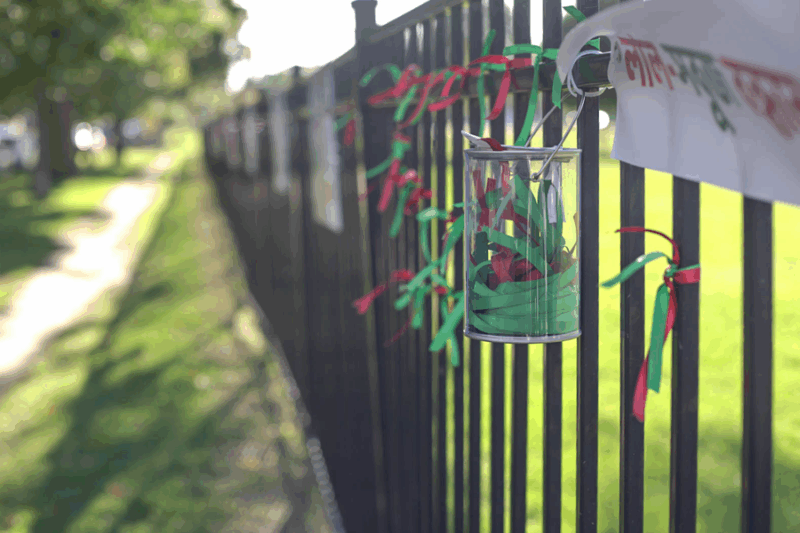
Red-Green Ribbon Memorial at Dentonia and Thyra
Imagine There’s No Quota was a project with two primary objectives: to activate civic engagement within the Bangladeshi Canadian diasporic community and to activate public spaces within that community through public art. The project emerged during a turbulent moment for Bangladesh and its global diaspora. In July and August 2024, Bangladeshis witnessed the fall of the ruling political party after fifteen years of undemocratic governance. The party’s violent and repressive response to a student-led protest escalated into a nationwide uprising demanding broader socio-cultural and political change. Although this shift initially brought relief, it was short-lived. New forms of unrest deepened ideological divisions among Bangladeshis worldwide.
Imagine There’s No Quota intervened in this atmosphere of fragmentation by creating a space for dialogue. It invited diasporic reflections on the historical and political context of the uprising and on its aftermath, believing that public art could serve as a site of healing and coexistence. The project aimed to accommodate multiple perspectives on the uprising and to imagine new futures for Bangladeshis worldwide.
The research component invited graduate students, writers, art workers, and journalists from the Bangladeshi Canadian community to participate in ethnographic interviews. Seven participants completed the process, while three withdrew due to the sensitivity of the subject matter. Many interviewees described nostalgic and deeply personal memories of the homeland. Speaking anonymously allowed them to articulate thoughts and emotions they had previously withheld, affirming that their diasporic perspectives held value in shaping dialogue about this pivotal political moment.
The questions evoked nostalgic and often deeply personal memories of the homeland.
The project became a catalyst for civic engagement. The public art outcome — a QR-code scannable audio-walk installation — extended this engagement into the public realm, transforming sidewalks, parks, and neighbourhood corners into spaces for reflection and critical inquiry. As the project progressed, it became clear that the Bangladeshi Canadian population in the Danforth–Victoria Park area has grown significantly, especially with the post-COVID influx of new immigrants and political asylum seekers. Sidewalks, once quiet, are now lively social spaces that have shaped how and where the installations are placed.
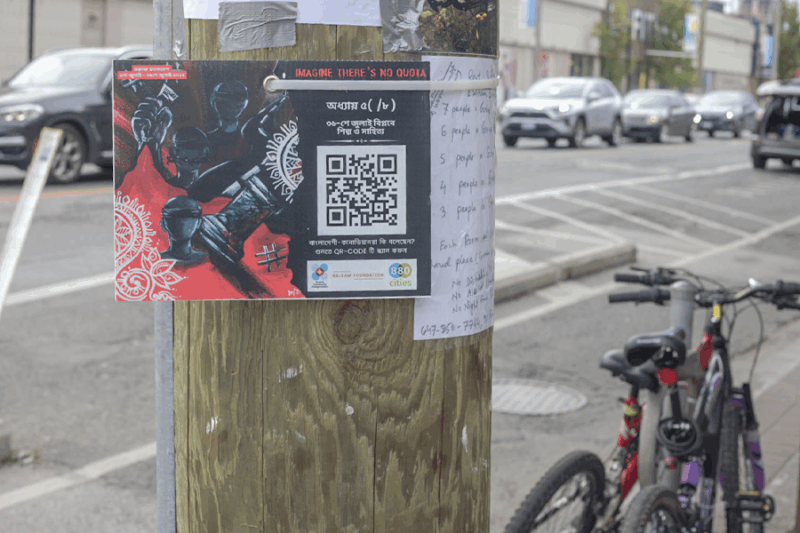
Audio Walk Series Installation on Danforth Sidewalk
However, political sensitivity created tensions. Several installations were damaged at multiple sites, reflecting resistance from those who felt the project challenged their political beliefs. Online responses included trolling and abusive comments. These reactions demonstrated that the installation created a real space for civic dialogue—one in which differing and even opposing viewpoints could emerge.
The launch event on August 23 at the Shaheed Minar area included invited community speakers and was supported by strong partnerships with Bangla Kagoj newspaper and Climate Channel TV. Outreach to political representatives proved difficult, clarifying that future phases may require approaching them through community organizations rather than as an individual artist. Securing a City of Toronto park permit was another major challenge, with approval arriving just one week before the launch.
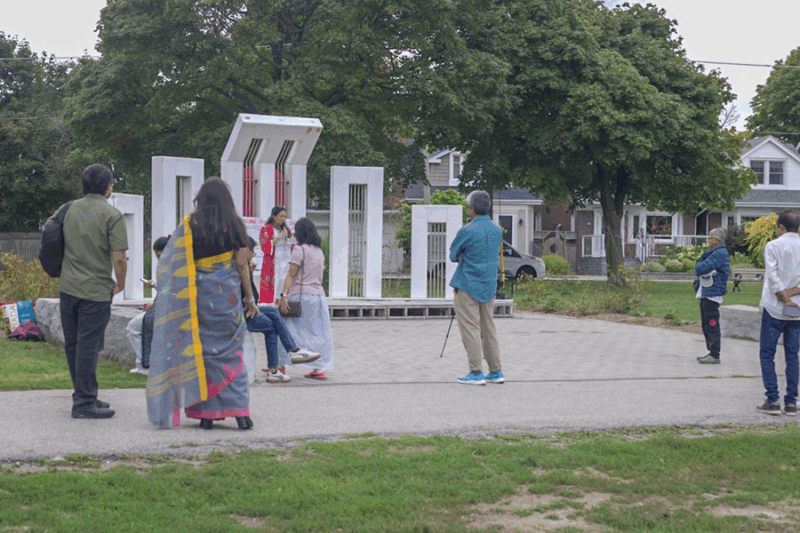
Project Launch
Despite this, the project received significant attention. The QR-code audio walk achieved considerable views, encouraging Mushtari to begin planning the next phase, which will document diasporic reflections on the uprising’s aftermath in greater detail.
Mushtari also reflected in the broader community context. The Bangladeshi Canadian community in the Greater Toronto Area is rich and dynamic, shaped by vibrant art, culture, music, literary practices, and cuisine. Recent immigration has made it even more diverse and complex, generating new conversations that influence both internal community relations and the broader Canadian discourse. Yet following the 2024 political uprising in Bangladesh, tensions have deepened within the diasporic community, creating barriers to the kind of dialogue necessary for democratic practices. Rather than imagining a utopian future, Mushtari envisions a reasonably functional democratic community that embraces coexistence, diverse perspectives, and constructive participation.
In a divided community, facilitating dialogue and fostering an agonistic rather than antagonistic public space is vital.
About Mushtari Afroz
Originally from Bangladesh, Mushtari Afroz is a Toronto-based dance artist and artist-researcher whose work explores public space as a site of dialogue, participation, and political expression. Her praxis-driven practice investigates spatial justice in urban environments, examining gentrification, the relationship between space and place, and the concept of publicness. Mushtari integrates art as a political tool, using dance, music, and theatre to create site-specific performances that engage with socio-spatial issues in neoliberal cities and foster active citizenship.
Instagram: @afrozmushtari
Facebook: @Mushtari Afroz
#publicspacepraxis #civicengagement