
Finding Common Ground
Two White Feather
Cambridge
Two White Feather’s project grew from the intention to sit with encampment residents in a way that honoured their humanity, their stories, and their struggles. Over the past year, it has become a place of refuge, resistance, and relationship-building at the 100 Vic encampment. Rooted in Indigenous worldviews and guided by the desire to interrupt cycles of displacement, the project supported residents through acts of care, shared ceremony, creative resistance and public education. Even in the face of conflict, systemic barriers and lateral violence, the work continued with a commitment to healing, reciprocity and community care.
A Year of Finding Common Ground
The intention behind Project Finding Common Ground was to cooperatively build a refuge at a local encampment under scrutiny, to assist residents existing there while also serving as a marker for increased transformative justice measures in response to publicized crises, including mental health and emotional safety issues and inadequate physical living conditions. It was the hope that by addressing the ills plaguing the community—colonialism, ableism, capitalism and racism—that the consequences of this way of knowing and doing—disconnection, isolation, displacement, stigmatization, criminalization, homelessness, poverty and health inequities—would be alleviated and the cycle of chronic homelessness including the traumatic displacement of Indigenous folks and those who are marginalized in intersectional ways would be interrupted.
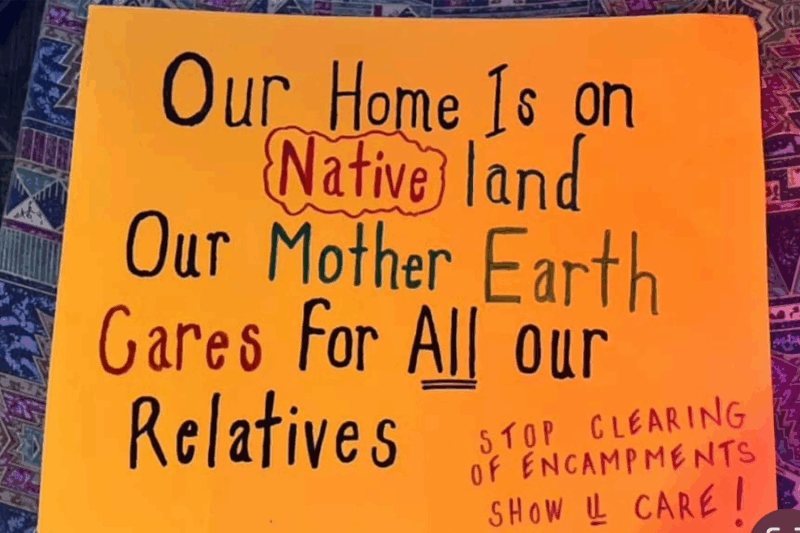
The outreach and activities facilitated with encampment residents renewed life and supported overall well-being at 100 Vic and in the surrounding community. Activities such as Hallowe’en Candy Scramble and Pumpkin Carving, crafting, smudging, offering natural remedies, site clean-ups, supportive chats, sharing firewood, gifting Stockings 4 the Soul, preparing a Holiday Feast through the Reverse Advent Calendar, and decorating a Tree of Warmth with winter wear helped residents feel valued.
Some residents commented that they felt like “normal people” and that they enjoyed the down-to-earth company in contrast to those who sat in their cars and watched security or those who simply dropped off supplies and left.
Public education about homelessness, substance use, mental health, trauma and neurodiversity through social media posts, podcast episodes and artivism projects helped raise awareness about the need for land back and for better care of all our relations. Participation in demonstrations of solidarity, including protests, petitions, and written submissions, helped give a united voice for shifting from punitive measures to empowerment and collective responsibility.
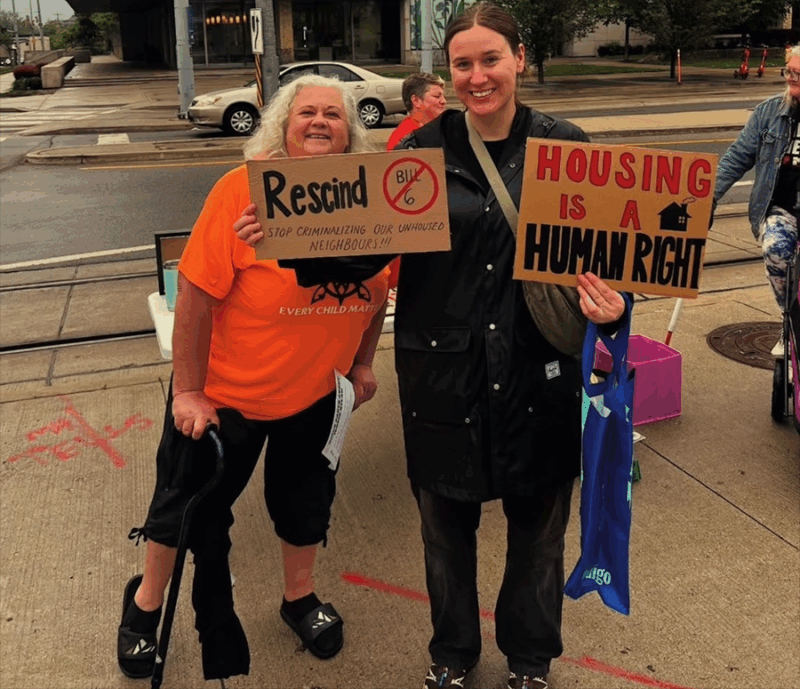
Over the past year, it has become clear that the Region of Waterloo is determined to build its transit hub at the expense of the livelihoods of vulnerable people. There remains a great divide between the haves and the have-nots, as well as those who care enough to be part of the solution and those who are only interested in maintaining the inequitable status quo while scapegoating the unhoused, the poor, the substance user, the mentally ill, and the People of the Land. The encampment residents remain resilient amid overwhelming resistance and harsh conditions. This is where Finding Common Ground belongs.
Challenges arose in the form of horizontal hostility from the partner group, leading to the difficult decision to abandon the original vision of mobilizing residents to build a lodge and a tipi. After conflict and mediation attempts, it became clear that finding common ground with this partner was not possible at this time. Efforts shifted toward standing with others in ways that understood and encouraged diverse approaches to revolutionizing, not rebelling.
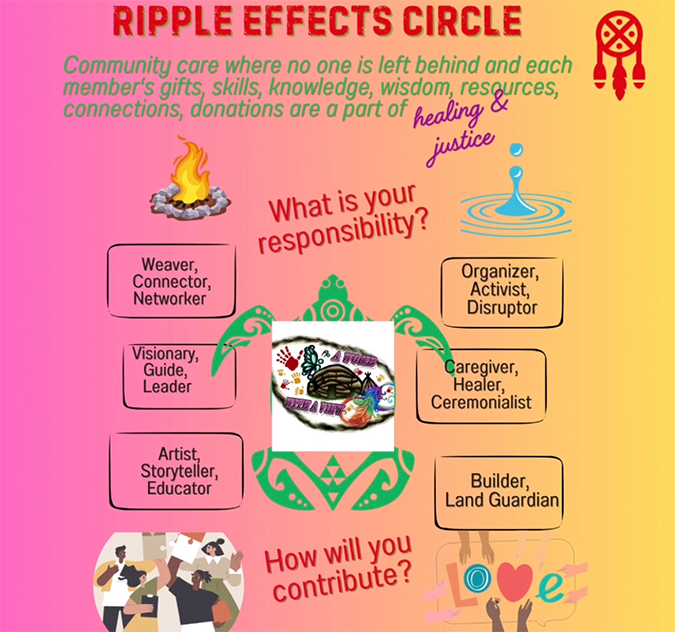
Artivism and craftivism became the guiding approach, and new collaborations formed with groups committed to encampment justice. Ripple Effects Circles invited potential Community Helpers to take on shared responsibility, and although attendance was low, those who came forward remain committed.
Looking ahead, the project will continue practising transformative justice through relationship-building and co-facilitating Circles to assess capacity to build a lodge and tipi that promote healing for those living off the land. Wellness Warrior Peer Support Training will be initiated, with participants helping implement crisis supports, outreach, accompaniments and wellness programming.
Two White Feather’s leadership reflects the teachings of an Indigenous Warrior whose service is grounded in community care, cultural teachings and walking alongside others on the Red Road path. They shared that taking time to do more healing work is essential so they can be a Warrior who knows their limitations and blind spots as they work toward becoming a stronger and more reliable contributor to this project and to the larger vision of A Womb With a View.
Warriors get injured in battle and they too must rest, take stock of what really matters and mend themselves.
As winter approaches, efforts will extend to other encampments being targeted with sweeps. The commitment to solidarity, mutual aid and making beautiful remains steadfast. A Womb With A View continues to guide the long-term vision: a vacant lot returned to a team of Wellness Warriors dedicated to collectively building a crisis-response alternative by, with, and for marginalized folks. This healing place would include a traditional lodge in the middle, surrounded by 4 Directions Tipis for crisis stabilization, transitional support, and caregiver respite, along with a community food and sacred medicine garden, an emotional support dog run, and a therapeutic crafting social enterprise storefront. It is meant to feel like emerging from the sweat lodge after a physical, emotional, mental and spiritual cleansing that brings renewed hope and energy for change.
About Two White Feather
Two White Feather is Anishinaabe from Saugeen First Nation who is currently residing in Waterloo Region. After surviving disconnection from family, displacement from community, forced assimilation into child welfare and youth justice systems, suicide attempts and overdoses while transient, tasering and arrest during a crisis intervention, early loss of his parents, he has found his way on the Red Road while demonstrating that mino-bimaadiziwin (living the good life) is possible – even if navigating with a vulnerable brain and mental health challenges. What aided him in his own healing has given birth to grassroots, peer-led, culturally relevant crisis response alternative.
Facebook: @A Womb With A View
YouTube: @AWombWithAView
#findingcommonground #transformativejustice #crisisresponsealternative